

Scenario One:
“Okay, sir, I just want to let you know that you’ll be here for at least 4 hours while we repeat your cardiac enzymes. So here’s the remote and call button. Let us know if your pain comes back.”
“YOU MEAN I HAVE TO WAIT THREE HOURS TO SEE A DOCTOR?” He screams in frustration.
Scenario Two:
“So, how was Dr. N? Was she kind? Did she listen to you?” My attending and medical director asks a patient that I have seen multiple times and just recently updated on his negative work up in the ED.
“Who?” The patient answers quizzically.
“The young woman that came in. The one that just told you that your labs were fine and you were going home.”
“Oh, that young girl? I thought she was a nurse.”
Being in residency, I have attendings who can teach me how to perform a chest tube, illicit a history that can lead me to the right diagnoses, and to interpret lab results. But, my residency is staffed almost completely with older white males that illicit the image of a quintessential doctor in pateints’ minds. They don’t walk into rooms and immediately have to repeat themselves that they are the doctor and assuage worries that I’m “too young” or “too female” to take care of them. They don’t have to tiptoe the line between being seen as a leader or a bitch. They don’t have to be seen as deficient.
And it’s been lonely swimming in that ocean by myself. I’ve had to weather storm after storm by myself, sometimes I am able to swim to shore safely. And sometimes, it’s all I can do to keep my head above water. I have had to learn on the job on what to say to assuage those fears, maintain relationships with nurses when I have to ask for a lab to be drawn three times, and how to make myself look like a doctor. I have had to figure these things our on my own.
On those days that I can barely keep my head above water, I’ve looked around for someone who looks like me [female] to hold onto as a buoy or rock in that water. Unfortunately, I have been alone in that sea. Until, FeminEM and Fix 17.
I was a scared second year resident who had never even gone to a movie on my own. And I signed up to travel to New York City and attend a new conference about females in Emergency Medicine. I was ecstatic to find a group of women who might be experiencing the same things I had, who could relate and empathize, and, most importantly, who could guide me. I didn’t have to swim alone anymore.
I was anxious and nervous the entire month leading up to the conference. It was my first professional conference in which I was going to be an actual Emergency Medicine physician and not a med student “hoping to be” one. I was anxious that I was going to be seen as less than for just being a resident, from being from a community hospital in the Midwest, and for being alone. Why should these women want to help me or be friends with me if I couldn’t even get another person to come with me somewhere for a few days?
I couldn’t have been more wrong.
That first FIX changed my life. I cried, laughed, and loved in that theater. I learned that we had to stand on the shoulders of those that came before us to advance even more. I found mentors and women who had come before me willing and happy to share their experiences and insights. I was freely and happily given contact information along with a hug. And for the first time in the rough seas of residency, I had buoys to hold onto.
That feeling boosted for me another year. I went back to my home institution and promised that the other female residents had to come with me the next year. Every time a patient mistook me for a nurse, didn’t trust that I could be a doctor given the youthfulness of my face or the genitals between my legs, I was buoyed by those other swimmers. I knew I wasn’t alone. I knew that they might not physically be next to me, but they were definitely weathering those waters with me.
Day after day, I walked into that Emergency Department with my head held high (some days were easier than others to keep my head held high) and saw patients. I treated patients for a range of complaints ranging from the mundane to the more life-threatening. And before I knew it, it was September 2018 and FIX 18 was just around the corner. But this year, I was excited instead of afraid to be in that auditorium.


Or, more accurately, our buoys were a raft. Hearing the stories of these women (and a few men) made me realize that these women weren’t above me in the water like a buoy. They were still experiencing the same discrimination, fear, and uncertainty that I was feeling. They were next to me in the water. However, they were holding a hand out to let me know I wasn’t alone.
As Dara Krass said, female otters, known as “bitches”, link together by holding hands to form a raft, which will always lovingly be known as a “raft of bitches”. These “rafts of bitches” allow otters to survive in the dangerous waters much easier than if they were to weather the waters alone. Just like us.
Each of those speakers held out a hand to every audience member. Each participant held out a hand to the audience member next to them. Quickly, the FeminEM community became a “raft of bitches”. We were able to laugh, cry, and learn together. We were able to see how our unique circumstances and abilities made us valuable to that raft. We were able to support each other. We were able to allow those struggling to keep their head above water to rest for just a second. We were able to just be.
But most importantly, we learned that our raft always has room for one more. Since otters’ rafts grow by holding hands, there is always an open and waiting hand at either end of the raft. And when that hand finds another hand, the newly minted member also has an open and waiting hand.
Last year, we stood on the shoulders of those before us. This year, we held their hand. What are we going to do next year?
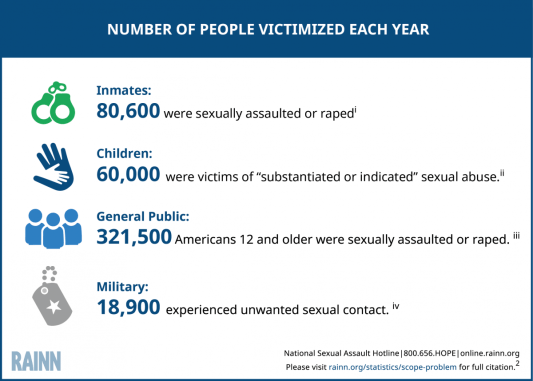 the expanse of the problem was made to have a face. Over 500,000 people tweeted #metoo, some with a story, some with just those two words. Females in all walks of life, all ages, all races stood up and made their voice heard – some for the very first time. I spent all weekend watching these brave victims talking about their experiences. And often, how the victims felt like they couldn’t do anything either to protect themselves or to get justice. Likely with good reasons too, according to RAINN, 99% of sexual violence perpetrators do not get convicted. Stories of backlash, people not believing them, people blaming them popped up so quickly that I didn’t even have time to finish reading the first before another showed up. Women stood up and shouted “Me too!”. No longer were they afraid of what could happen to them in retaliation. No longer were they afraid of how people they would view them after their disclosure. No longer were they afraid. If I have ever seen people exemplifying “Fuck Politeness” and the sense of “My Favorite Murder” it was this weekend!
 The Basic Batch